Introduction
One of the most frequently asked questions by defense professionals is how does a military anti tank barrier work to stop or disable armored vehicles. Military anti-tank barriers are among the most effective non-explosive defensive tools used by armed forces worldwide. Understanding how a military anti tank barrier how does it work context is essential for military planners, defense contractors, and security professionals who need to protect forward operating bases, checkpoints, and strategic infrastructure. Unlike active countermeasures such as mines or rocket-propelled grenades, anti-tank barriers rely on physical mechanics to engage a vehicle's running gear — its tracks, wheels, and suspension — to achieve what military strategists call a "mobility kill."
These barriers come in various forms, from massive concrete pyramids to portable wire mesh mats, but they all share a common goal: prevent a vehicle from advancing. The working principle behind anti-tank obstacles varies by design, yet each type exploits fundamental physics — weight distribution, traction loss, or mechanical entanglement — to neutralize the vehicle's mobility advantage. This article explains every major mechanism, deployment method, and tactical consideration behind modern anti-tank barriers, answering the most common questions about how these defensive systems operate in real-world military scenarios. Understanding military anti tank barriers work principles helps planners select the right obstacle for their specific defensive requirements.

What Are Military Anti-Tank Barriers?
Defining Anti-Tank Barriers in Modern Warfare
An anti-tank barrier is any engineered structure designed to stop, delay, or disable tracked and wheeled military vehicles. To understand how military anti-tank barriers work — and specifically the question of military anti tank barrier how does it work — one must first recognize that these are passive defense systems. They require no power source, no operator, and no ammunition. They function purely through mechanical interference with a vehicle's mobility systems. The most common modern variants include portable anti-tank wire mesh barriers, concrete dragon's teeth, steel hedgehogs, and ditch-and-berm combinations.
Types of Anti-Tank Barriers
There are several distinct categories of anti-tank obstacles, each employing a different mechanism to achieve the same result. Anti-tank wire mesh barriers use high-tensile steel cables or wire mesh that entangle a vehicle's tracks and drive sprockets. Concrete "dragon's teeth" are pyramid-shaped blocks that force a tank to climb, exposing its vulnerable underbelly or causing it to high-center. Steel hedgehogs (also called Czech hedgehogs) are anti-tank barriers made from welded steel beams that interlock and cause a vehicle to tip or become stuck. Anti-tank ditches are wide excavations that a vehicle cannot cross without bridging equipment.
Historical Development of Anti-Tank Obstacles
The concept of barriers designed to stop military vehicles emerged during World War I with the introduction of tanks on the battlefield. By World War II, anti-tank obstacles had evolved into sophisticated defensive systems. The famous Czech hedgehog and dragon's teeth were deployed extensively along the Siegfried Line and Atlantic Wall. Modern iterations have shifted toward portable, rapidly deployable solutions like anti-tank wire mesh barriers that can be carried in a backpack and deployed by a single soldier. This evolution reflects the changing nature of warfare — from static defensive lines to dynamic, expeditionary operations where speed of emplacement is critical.
The Working Principle Behind Anti-Tank Obstacles
The working principle behind anti-tank obstacles can be distilled into three fundamental physical mechanisms: traction denial, geometry-based immobilization, and entanglement. Each mechanism targets a different vulnerability of armored vehicles, and understanding these principles explains how military anti-tank barriers work — and more broadly how military anti tank barriers work at a mechanical level.
Energy Absorption and Mechanical Disruption
When a tank drives over or into an anti-tank barrier, the obstacle absorbs and redirects the vehicle's kinetic energy. A typical main battle tank weighs between 50 and 70 tons, producing enormous momentum. Anti-tank wire mesh barriers exploit this weight by allowing the vehicle's tracks to become entangled in loops of high-strength steel cable. As the tank continues to drive forward, the cables wrap around drive sprockets, road wheels, and track links, gradually increasing resistance until the tracks jam or snap. This energy dissipation mechanism is what makes wire mesh anti-tank barriers so effective despite their lightweight, portable design.
Track and Running Gear Engagement
The most vulnerable part of any armored vehicle is its running gear — the tracks, wheels, suspension arms, and drive sprockets. Anti-tank barriers are specifically designed to engage these components. Concrete dragon's teeth force a tank to climb, exposing the thin belly armor beneath the hull. Anti-tank ditches cause the vehicle to nose-in, trapping the front end while the rear tracks spin uselessly. Wire mesh barriers wrap around rotating components, pulling the mesh tighter as the vehicle struggles. The principle is consistent across all types: attack the mobility system rather than attempting to penetrate armor. This is why anti-tank obstacles remain relevant even as vehicle armor technology advances — they target components that cannot be armored without sacrificing mobility.
Physics of Vehicle Arrest
When a tank contacts a properly designed anti-tank barrier, several physical effects occur simultaneously. The vehicle's center of gravity shifts as it climbs over an obstacle, reducing traction on the rear tracks. Ground pressure — normally distributed across the track area — becomes concentrated at the point of contact with the obstacle. For wire mesh barriers, the entanglement creates a progressively tightening grip that increases friction until the drive system stalls. The total stopping force depends on the vehicle's speed, weight, and the barrier's anchoring strength. A well-anchored anti-tank barrier can stop a 70-ton tank traveling at 15 mph in under 10 feet of travel.
How Anti-Tank Wire Mesh Barriers Immobilize Vehicles
Among all anti-tank obstacle types, wire mesh barriers are the most portable and rapidly deployable solution available to modern military forces. The mechanism that anti-tank wire mesh barriers use to immobilize vehicles is fundamentally different from rigid concrete or steel obstacles. Understanding how military anti tank barriers work in wire mesh form requires examining the entanglement physics rather than brute-force blocking.
Wire Mesh Mechanism: Tangling and Entanglement
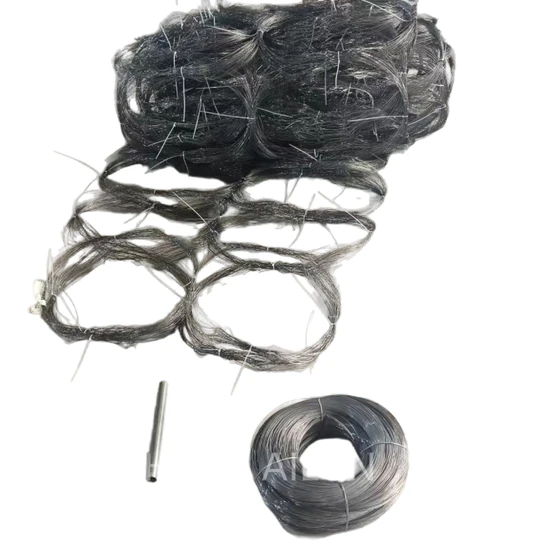
Anti-tank wire mesh barriers consist of woven or welded high-tensile steel cables arranged in a grid pattern with large openings — typically 4 to 6 inches. When a tracked vehicle drives onto the mesh, the tracks grab and pull the flexible material into the running gear. Unlike rigid obstacles that a tank can simply push aside or climb over, the wire mesh follows the path of least resistance: it wraps around the drive sprockets, road wheels, and return rollers. As the vehicle continues to move, the mesh tightens around these components, creating a progressively binding grip. Within seconds, the entanglement can stall the tracks completely, strip track pads from the drive sprockets, or sever hydraulic and electrical lines routed along the hull.
Mobility Kill Strategy in Combat
Military doctrine refers to this type of disabling as a "mobility kill" (M-kill). Unlike a catastrophic kill that destroys the vehicle outright, a mobility kill renders the target immobile while leaving the crew alive — often preferring this outcome because it forces the enemy to dedicate recovery resources or abandon the vehicle entirely. Tactical deployment of anti-tank wire mesh barriers is typically combined with other defensive layers: the mesh stops the vehicle in a kill zone where anti-tank guided missiles (ATGMs), artillery, or small arms fire can engage the now-stationary target. This layered defense approach maximizes the effectiveness of wire mesh anti-tank barriers by using the entanglement to create a firing window for other weapons systems. The mesh itself is lightweight enough that a single soldier can carry a roll measuring 15 feet by 50 feet, and multiple rolls can be linked together to create barriers spanning hundreds of feet.
How Does a Military Anti Tank Barrier Work to Stop Vehicles?
Military Anti Tank Barrier How Does It Work to Stop Vehicles
To fully answer how an anti-tank barrier stops a tank or military vehicle, it helps to examine the stopping sequence from the moment of first contact through complete immobilization. The process varies by barrier type, but the end result is the same: the vehicle cannot advance. Understanding the military anti tank barrier how does it work question requires looking at both rigid and flexible barrier designs.
Physical Obstruction and Vehicle Arrest
Rigid anti-tank barriers such as concrete dragon's teeth and steel hedgehogs stop vehicles through direct physical obstruction. When a tank attempts to climb over a dragon's tooth — a pyramid-shaped concrete block roughly 3 to 4 feet tall — the vehicle's front end rises, shifting its center of gravity rearward. If the obstacle is tall enough relative to the vehicle's ground clearance, the tank either high-centers on the obstacle (its belly rests on the peak while the tracks lose contact with the ground) or tips its front end over the obstacle and crashes down with such force that the suspension or underbelly is damaged. Modern main battle tanks have ground clearance of 16 to 20 inches, making them vulnerable to obstacles just 24 to 36 inches tall. Anti-tank ditches exploit a different physical principle: a wide trench (12 to 20 feet across) prevents the vehicle from crossing because its track length cannot span the gap. When the tank noses into the ditch, the front end drops and the vehicle becomes trapped with its tracks unable to gain purchase on either edge.
Immobilization Through Mechanical Interference
For flexible anti-tank barriers like wire mesh, the stopping mechanism is progressive rather than instantaneous. As the vehicle drives forward, the mesh wraps around rotating components — drive sprockets, road wheels, and track return rollers. Each rotation pulls more mesh into the mechanism, increasing the tension. The military anti tank barrier essentially uses the vehicle's own power against it: the harder the driver accelerates, the tighter the mesh binds. Eventually, the track tension exceeds design limits and the track either snaps or derails from the road wheels. Once a track is disabled, the tank is effectively immobile regardless of its armor or armament. Field tests have demonstrated that a properly anchored anti-tank wire mesh barrier can immobilize a 60-ton main battle tank in under 5 seconds of contact. This rapid disablement is critical in combat scenarios where every second of vehicle exposure translates to increased vulnerability to enemy fire.
Installation and Deployment of Anti-Tank Barriers
Understanding how anti-tank barriers are installed in military bases and how military engineers deploy anti-tank barriers in defensive positions is crucial for defense planners. The way military anti tank barriers work in practice depends heavily on proper installation technique. Installation methods differ dramatically between permanent base defense and temporary tactical deployment. Similarly, how long does it take to set up a temporary anti-tank barrier depends on the type, crew size, and ground conditions.
Permanent Installation at Military Bases
Permanent anti-tank barrier installations follow a structured engineering process. For concrete barriers such as dragon's teeth or vehicle-reinforced walls, the process begins with site survey and ground preparation. Engineers mark the barrier line based on the site's key terrain features — road approaches, open fields, and likely vehicle approach routes. Concrete barriers are either precast and transported to the site or poured in place using forms. A standard installation of 500 linear feet of concrete dragon's teeth requires a crew of 10-12 engineers working 2-3 days, not including concrete curing time. Steel hedgehog barriers require welding teams and heavy equipment for placement. Anti-tank ditches require earth-moving equipment and typically take 1-2 days with a bulldozer crew. These permanent installations are designed for long-term base defense at forward operating bases, command posts, logistics hubs, and critical infrastructure.
Rapid Field Deployment by Military Engineers
Temporary anti-tank barriers prioritize speed and portability over permanence. Anti-tank wire mesh barriers are the gold standard for rapid deployment. A single roll weighing approximately 40-60 pounds can be carried by one soldier and deployed by a two-person team. The mesh is unrolled across the approach route and anchored using steel pickets or ground stakes driven into the soil. For optimal effectiveness, engineers deploy the mesh in overlapping layers at a 45-degree angle to the expected approach direction. Military engineers can deploy 100 linear feet of anti-tank wire mesh barrier in 10-15 minutes with a 4-person team. This speed enables battlefield commanders to establish anti-tank obstacles during tactical pauses, night operations, or while under the cover of suppressive fire.
Setup Time for Temporary Barriers
The setup time for temporary anti-tank barriers varies by type and conditions:
| Barrier Type | 2-Person Crew | 4-Person Crew | 6-Person Crew |
|---|---|---|---|
| Wire Mesh (100 ft) | 20-25 min | 10-15 min | 5-8 min |
| Steel Hedgehog (single unit) | 10 min | 5 min | 3 min |
| Quick-crete Barrier (modular) | 45 min | 25 min | 15 min |
| Anti-Tank Ditch (small) | N/A | 2-3 hrs (with machinery) | 1-2 hrs (with machinery) |
These deployment times make anti-tank wire mesh barriers the preferred choice for mobile defense operations where units must establish and then rapidly displace to new positions. Understanding how military anti tank barriers work in deployment scenarios helps engineers plan defensive positions effectively.
Can Anti-Tank Barriers Stop Modern Armored Vehicles?
A common question among defense professionals is can anti-tank barriers stop modern armored vehicles and tanks — particularly advanced platforms like the M1 Abrams, Leopard 2, T-90, or Challenger 2. The short answer is yes, but effectiveness depends on barrier type, placement, and the specific vehicle's design features.
Performance Against Modern Tanks and Armored Vehicles
Modern main battle tanks incorporate design features intended to reduce vulnerability to anti-tank obstacles. For example, the M1 Abrams has a ground clearance of approximately 19 inches and a track width of 25 inches, meaning that properly sized dragon's teeth must be at least 30 inches tall to effectively engage the underbelly. Modern Russian tanks like the T-90 feature rubber side skirts that protect the upper track run but can be torn away by wire mesh entanglement. Anti-tank wire mesh barriers remain highly effective against modern vehicles because the basic design of tracked running gear has not fundamentally changed in decades — drive sprockets, road wheels, and track links are still exposed and vulnerable to entanglement. In live-fire and mobility tests conducted by NATO forces, anti-tank wire mesh barriers consistently immobilized modern tanks when properly anchored and deployed. The mesh material itself has evolved: modern barriers use ultra-high-molecular-weight polyethylene (UHMWPE) or aramid fiber blends that are stronger than steel yet significantly lighter, enabling easier deployment without sacrificing stopping power.
Limitations and Bypass Techniques
No anti-tank barrier is 100% effective against all threats. Modern armored vehicles can attempt several bypass and countermeasure techniques against anti-tank obstacles. Armored bulldozers or combat engineering vehicles (CEVs) fitted with dozer blades can push aside wire mesh barriers or bury them under soil. Tank-mounted mine plows and rollers can sometimes tear through wire mesh before it can entangle the tracks. Some vehicles carry demolition charges specifically for obstacle breaching. Anti-tank barriers are also vulnerable to indirect fire — artillery strikes can destroy concrete obstacles or scatter wire mesh. For these reasons, military doctrine emphasizes that anti-tank barriers should always be covered by observation and direct fire. The barrier itself is not the complete defense; it is the trigger that creates a vulnerable target. Additionally, obstacles must be integrated with other defensive measures such as minefields, trenches, and infantry positions to prevent dismounted engineers from approaching and dismantling the barrier under cover of darkness or smoke.
Conclusion
Understanding how military anti-tank barriers work is essential knowledge for anyone involved in base defense, tactical planning, or military engineering. The question military anti tank barrier how does it work can be answered by examining the three main physical mechanisms: entanglement, obstruction, and mechanical interference. From the entanglement action of wire mesh to the brute force of concrete dragon's teeth, every anti-tank obstacle type exploits a fundamental vulnerability of armored vehicles: their running gear. By attacking the mobility system rather than the armor itself, these barriers achieve results that expensive anti-tank missiles cannot match — they stop vehicles without destroying them, impose logistical burdens on the enemy, and create engagement windows for other weapons.
The working principle behind anti-tank obstacles remains consistent regardless of the specific design: engage the tracks and running gear, disrupt the vehicle's momentum, and render it immobile. Whether deployed as a permanent concrete barrier at a forward operating base or as a rapidly emplaced wire mesh barrier during a tactical operation, these systems represent a cost-effective and battle-proven approach to armored vehicle defeat. As vehicle technology evolves with hybrid-electric drives and unmanned ground vehicles, anti-tank barriers must and will adapt — but the fundamental physics of entanglement and mechanical interference will remain relevant as long as armored vehicles rely on wheels and tracks to move across terrain.